Saturday, August 2, 2008

Rent a Green Thumb

A recent article in the NYTimes about an alternative method to get local produce on the table...

July 22, 2008

A Locally Grown Diet With Fuss but No Muss

Eating locally raised food is a growing trend. But who has time to get to the farmer’s market, let alone plant a garden?

That is where Trevor Paque comes in. For a fee, Mr. Paque, who lives in San Francisco, will build an organic garden in your backyard, weed it weekly and even harvest the bounty, gently placing a box of vegetables on the back porch when he leaves.

Call them the lazy locavores — city dwellers who insist on eating food grown close to home but have no inclination to get their hands dirty. Mr. Paque is typical of a new breed of business owner serving their needs.

Even couples planning a wedding at the Plaza Hotel in New York City can jump on the local food train. For as little as $72 a person, they can offer guests a “100-mile menu” of food from the caterer’s farm and neighboring fields in upstate New York.

“The highest form of luxury is now growing it yourself or paying other people to grow it for you,” said Corby Kummer, the food columnist and book author. “This has become fashion.”

Locally grown food, even fully cooked meals, can be delivered to your door. A share in a cow raised in a nearby field can be brought to you, ready for the freezer — a phenomenon dubbed cow pooling. There is pork pooling as well. At Sugar Mountain Farm in Vermont, the demand for a half or whole rare-breed pig is so great that people will not be seeing pork until the late fall.

Although a completely local diet is out of reach for even the most dedicated, the shift toward it is being driven by the increasingly popular view that fast food is the enemy and that local food tastes better. Depending on the season, local produce can cost an additional $1 a pound or more. But long-distance food, with its attendant petroleum consumption and cheap wages, is harming the planet and does nothing to help build communities, locavores believe.

As a result of interest in local food and rising grocery bills, backyard gardens have been enjoying a renaissance across the country, but what might be called the remote-control backyard garden — no planting, no weeding, no dirt under the fingernails — is a twist. “They want to have a garden, they don’t want to garden,” said the cookbook author Deborah Madison, who lives in Santa Fe, N.M.

Her neighbor Chase Ault, a business consultant, recently had a vegetable garden installed with a customized set of plants and a regular service agreement. “I am working 24-7 these days, but I wanted to have something growing in front of me,” Ms. Ault said.

Like organic food, which corporate manufacturers embraced in the 1990s, before it, local food is quickly moving into the mainstream. Last year, the New Oxford American Dictionary picked locavore as its word of the year. A National Restaurant Association survey this year of more than 1,200 chefs, many of whom work for chain restaurants or large food companies, found locally grown produce to be the second-hottest American food trend, just behind bite-size desserts.

For a growing number of diners, a food’s provenance is more important than its brand name, said Michelle Barry, who studies American eating patterns for the Hartman Group, a research firm in Bellevue, Wash. As a result, grocery stores are looking to repackage products like milk and cheese to play up any local angle.

That will be a boon to people who find that shortcuts are necessary if they wish to eat locally. “If you live on East 80th 14 floors up and all you have is a potted plant, it’s tough,” said Lynne Rossetto Kasper, the host of the radio show “The Splendid Table,” who recruited 15 listeners for a study on the subject. Researchers will record their struggles to make 80 percent of their meals from organic or local sources. Spices are the only exemption.

Lazy locavores would never go to such extremes. Rather, they might simply sign up with the FruitGuys. The company, which has offices in San Francisco and Philadelphia, will deliver boxes of local, sustainably raised or organic fruit right to the cubicle.

In the mood for a meal that reeks of community but does not necessitate a communal activity? Three Stone Hearth in Berkeley, Calif., which describes itself as a community supported kitchen, offers its customers the opportunity to make friends while making food from local, sustainable farms, but the worker-owned company also offers online shopping for people who do not have the time to pick up orders or participate in educational activities.

Customers 20 miles away in the affluent community of Mill Valley, for example, can pay $15 to have jars filled with Andalusian stew, made with pasture-raised pork, delivered to their door. The jars, of course, are returnable.

“It’s a very savvy crowd that understands how all the pieces of sustainable farming and nutrition fit together,” said Larry Wisch, one of five worker-owners at Three Stone Hearth. “But they don’t want the headaches of getting here.”

Or you could just have your private chef handle all your local food needs. At their Hamptons summer house, John and Lorna Brett Howard want to eat almost exclusively local, which means that in place of one trip to the grocery store, their chef, Michael Welch, makes several trips to farm stands and the fishmonger.

“What I’m seeing with my clients is not the trendiness or the politics,” Mr. Welch said. “They are looking only at taste.”

Mrs. Howard said she ate local vegetables growing up in northern Michigan and Chicago. But her husband, a private equity fund manager, ate a lot of expensive imported food with little thought about where it came from. But all that has changed.

“It’s like the first time you start drinking good red wine and you realize what you were drinking was so bad you can’t go back to it,” Mrs. Howard said. “It’s that same way with vegetables.”

The author Barbara Kingsolver, whose book “Animal, Vegetable, Miracle” was a best seller last year, did not have the lazy locavore in mind when she wrote about the implications of making her family spend a year eating local. But she celebrates the trend.

“As a person of rural origin who has lived much of my life in rural places,” she said, “I can’t tell you how joyful it makes me to hear that it’s trendy for people in Manhattan to own a part of a cow.”

Sunday, June 15, 2008

Sound of Music


One of the best parts about living in Rhode Island is that there's always some place new to explore. Yesterday I checked out part of the Blackstone River Bikeway in Lincoln/Cumberland. This paved path winds through marsh, and along the Blackstone River. Unlike the crowded East Bay Bike Path, this one was much more relaxed and there weren't as many serious speed demons. A nice place for a casual, scenic ride.

Since I had my mountain bike, I ventured onto one of the dirt trails which ran along a tributary for about a mile. At one point I was amazed by the noise of birds, it was almost deafening. No "Silent Spring" here. Sadly, I was just casually riding through this avian symphony, when some old guy walking towards me yelled at me saying I should use the $30 million bike path, and leave the walkers a trail. OK, seriously, I wasn't going fast and there was plenty of room for us to pass side by side. Later I thought of my comeback line: "I can share, can't you?". That put a dark cloud over my head until another guy passing on a bike later said hi. That's what I'm talking about- some manners! hahahaha.

If you're into fishing or kayaking, this looks like a good place to do both. I scouted out a few put-in spots and I saw a handful of people with rods. At the very least bring your bike and keep your eyes open for turtles, fish, frogs, and birds.

Locavore

Let's get this show on the road for a new season of local eating! Farmers Markets are now OPEN. Woohooo! I am starting the season by reading "Animal Vegetable, Miracle (A Year of Food Life)" by Barbara Kingsolver. It's about the author's family's journey eating foods as local as possible. It was an ambitious project which included moving and living/working on a farm. Currently I'm half way through but it's good.

One thing that the author introduced is the concept of a vegetannual to help us remember what kinds of fruits/vegetables are in season. Consider one plant as it grows from seed to maturity. The early parts like stems and leaves grow in the spring (baby greens, asparagus). Later come the flowers (broccoli). Then the soft fruits (like beans, peppers, tomatoes). Then the hard skinned fruits like melons (late summer) and squash (early fall). Finally, as this imaginary plant wraps up for the winter, it stores all of its sugars in the roots (potatoes). It's kind of an interesting concept but it makes sense as you track what is available at the farmers market during the seasons.

Now that you know what is in season (not imported from South America or across the country), it's important to know what to do with the goods. Check out the book's website for recipe ideas and more.

Saturday, June 14, 2008

Whole Foods Market in Cranston

Check out the new Whole Foods in Cranston, next to the Garden City Mall. It's sooo nice inside- it invites you to buy a lot so don't just stop in for an onion like I did.

Monday, November 12, 2007

Colors

Fall is the time for bright vibrant colors around here in New England so I thought I'd share some interesting colored foods for you. And no, I'm not talking about green ketchup.

Purple cauliflower is tasty and very bright. The ones that I've found around here are more flavorful than the traditional white kind.

Yellow or orange tomatoes
are almost commonplace these days but liven up a salad. I've found them to be firmer and not as sweet as ripe red ones.

Golden and striped beets Haven't tried the golden ones yet but that's next on my list.

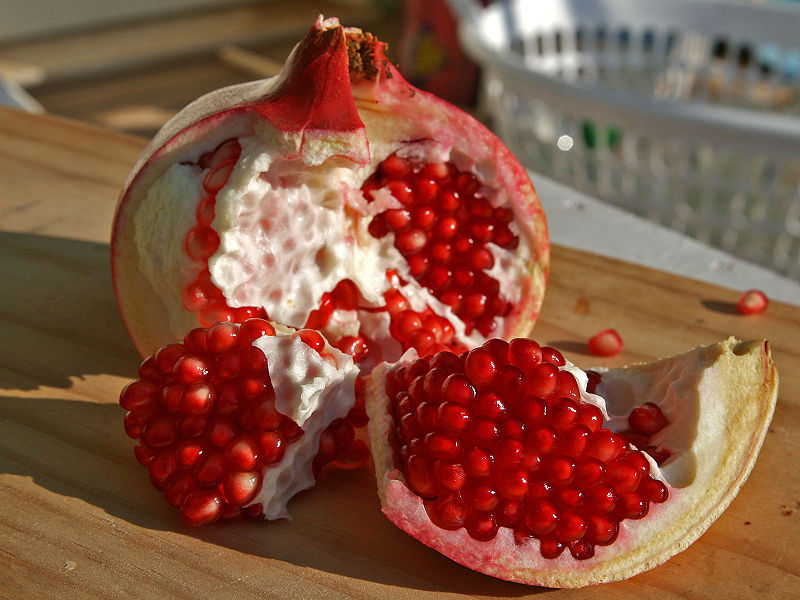
Pomegranate November is National Pomegranate month! These seem like fussy fruit but I've heard about their health benefits.

Sunday, September 30, 2007

Fall Favorites

Tomorrow is the first day of October. Where does the time go? It is funny how you can see the season progress through the farmers' markets. [BRB, have to watch a news segment on skinny whales as requested by mom.] I don't have any pictures yet but here's a quick run down of the bounty at the local market: apples- lots of them (it seems like everyone has apple trees), corn- very tasty, potatoes, onions, squash (incl. pumpkins), greens, beets, carrots, and still some tomatoes that they are trying to unload but at this point everyone is sick of tomatoes. If you didn't buy them, no doubt you know someone who grew them and had PLENTY to share with neighbors. I've gotten to the point where I am now buying stuff to cut and freeze for the winter. I'm too lazy to figure out canning, pickling, etc. but I can slice up a few peaches to save for later.

Last week I made my first apple pie of the season; it was a huge hit! (Tip: It's all in the crust and keeping you fats as cold as possible until it's ready for the oven.)

When you have a moment, check out this link http://sustainability.publicradio.org/consumerconsequences/ about sustainable communities. The website asks you a series of lifestyle questions and figures out how many earths would be needed if everyone lived like you do. It's a bit of a silly exercise because there is no way everyone would live the same way but it gets you thinking about stuff like your commute to work.

Sunday, August 5, 2007

Animal Attraction

This post actually has NOTHING to do with my eating local experiment but something very strange happened today that I thought I'd share.

So no sh*t, there I was... sitting by the lake in Lincoln Woods this afternoon when things got weird. After sitting on the rocks, not 1 foot from the water's edge, 5 Canada geese swam over to me. They were closely followed by 2 ducks. The parade of pan-handling birds obviously thought I would give them food. When they realized I didn't have anything, they literally turned their tail feathers in my face and swam away. About 15 minutes later, after the birds had moved to others along the shore, I looked down and there was a minnow in the water. This minnow was swimming as close to the waterline as possible and still stay submerged. I wasn't feeding him either. The minnow must have sent out some sort of bat signal because 2 more fish swam up to me. The water in the shallow area was pretty clear so I KNOW they saw me.

While observing all this I was thinking that in the most remote parts of the world where animals don't see humans, they don't know to fear them. However, Lincoln Woods is pretty popular with people so I figured these birds and fish are being fed and are a bit more domestic than your garden variety wildlife. Please Don't Feed the Bears. Put the "Wild" Back in Wildlife.